Research
Applied ML research in NLP, development economics, and recommender systems.
Trading Engagement for Sustainability: Carbon-Aware Re-ranking for E-commerce Recommendations
Jun 2026arXiv preprint (cs.IR)
Carbon-aware product recommendation when PCF labels are sparse: a retrieval-augmented pipeline transfers supervision from the Carbon Catalogue to a large catalog via similarity search, few-shot LLM prompting, and nearest-neighbour fallback, then post-hoc re-ranks BPR, NeuMF, and LightGCN scores with a single tunable λ trading engagement for estimated footprint. Evaluated on Amazon Reviews (Home & Kitchen, Sports & Outdoors, Electronics); λ sweeps yield Pareto frontiers showing substantial carbon reductions at small engagement cost, with headroom varying by model and category. With Anders Vestrum and Jorgen Bergh.
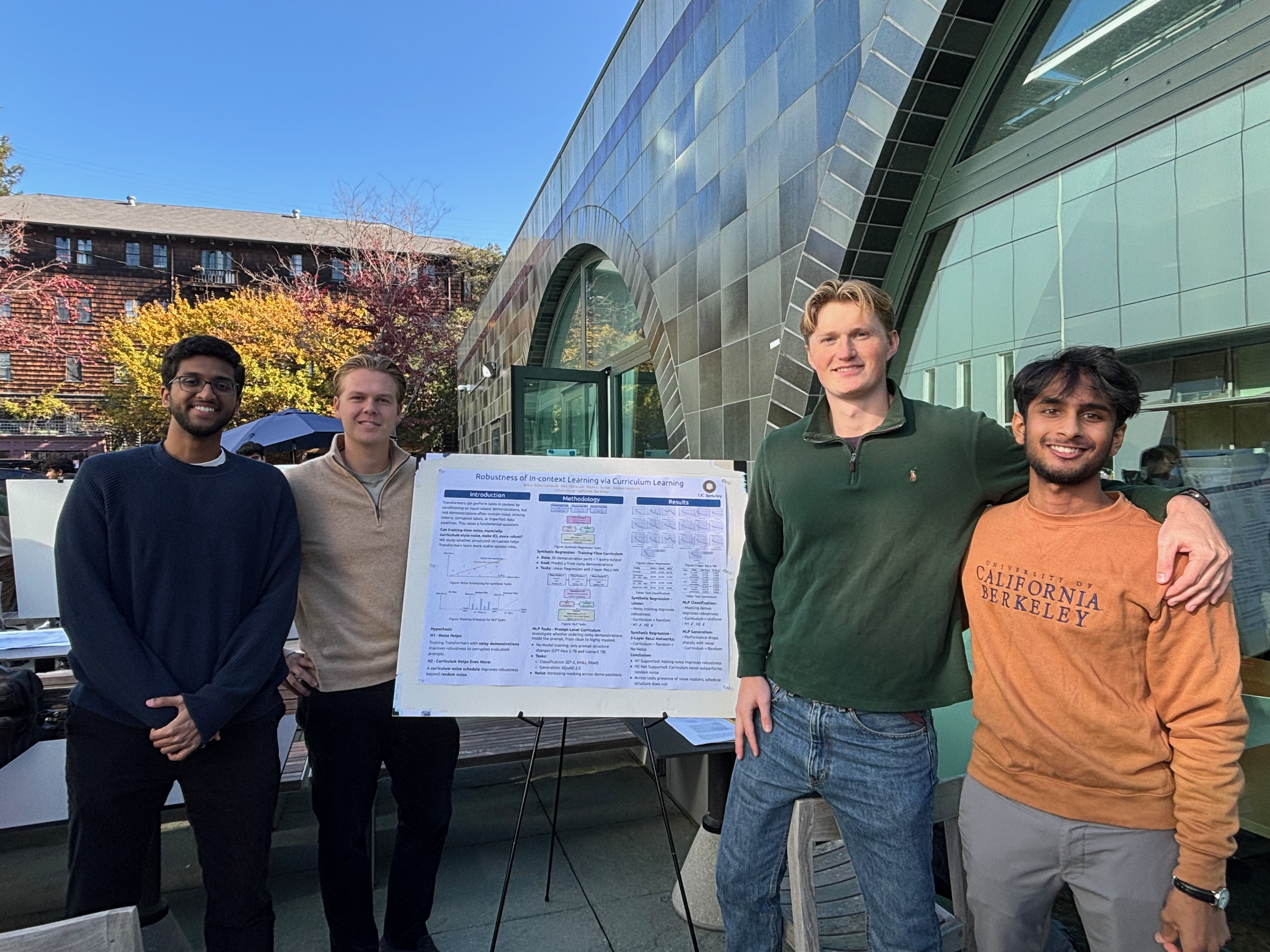
In-Context Learning Robustness via Curriculum Learning
2025UC Berkeley (EECS 282)
Trained GPT-style Transformer models to study robustness of in-context learning under noisy demonstrations across synthetic regression and NLP benchmarks. Evaluated curriculum-based noise schedules on GPT-Neo 2.7B and Llama-2 7B.
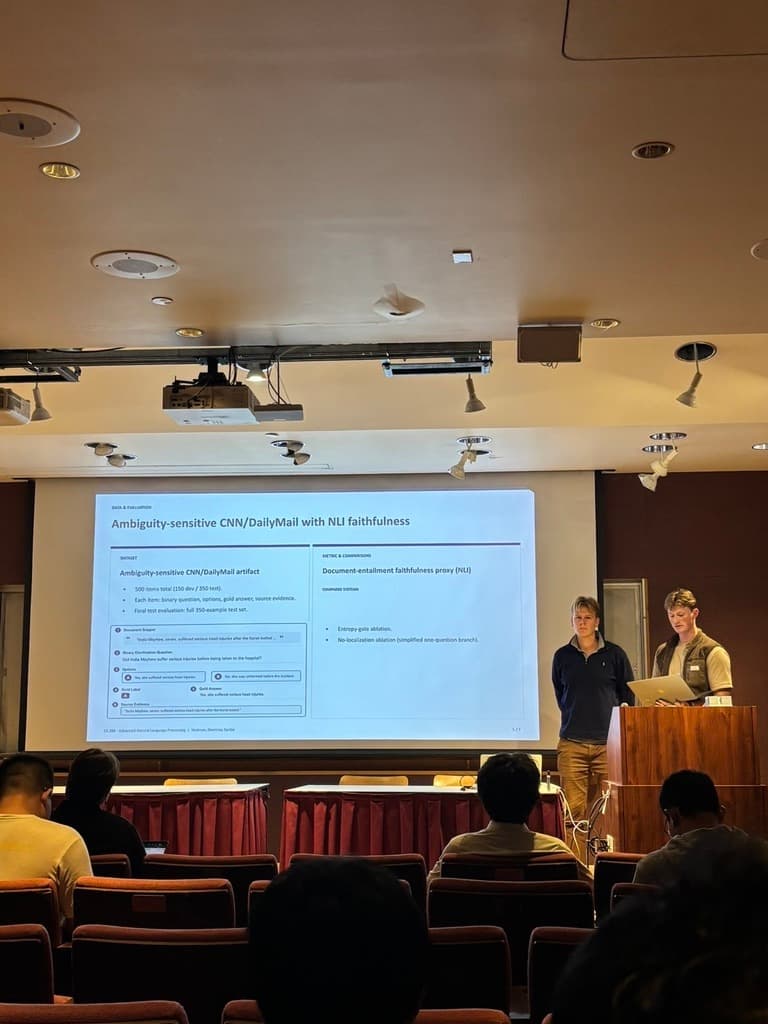
Ask Before You Summarize: NLI-Guided Uncertainty and Clarification-Aware Abstractive Summarization
2026UC Berkeley (CS 288)
Clarification-aware abstractive summarization that samples diverse candidates, builds an NLI-based semantic graph, and gates on a global uncertainty score before optionally asking one binary clarification and regenerating. We introduce AmbigSum (500 CNN/DailyMail-derived examples with clarification annotations) for evaluation. On the 350-example test split, the full pipeline achieves mean document entailment 0.567 (ask rate 0.42), improving over a greedy BART baseline (0.498; Δ = +0.069, p < 0.001), with larger gains where the gate triggers clarification.
Where Global Travel-Time Maps Miss Seasonal Access: A Route-Level Risk Dashboard for Rural Zambia
2026UC Berkeley (INFO 288)
Tests whether the Weiss et al. global healthcare travel-time map tracks DHS-reported access barriers equally across Zambian provinces and seasons, using two independent DHS waves. Performance differs sharply by province; we train a route-level model that augments travel time with precipitation, route geometry, and accessibility features to predict cluster-level shares reporting distance as a major barrier, exposed as seasonal risk scores in an interactive dashboard.
Connectivity and Data Management for Environmental Monitoring
2025NTNU x NINA
Bachelor thesis project developing a scalable system to manage and visualize passive acoustic environmental data, improving automated biodiversity monitoring workflows.